Design Ops
Design Systems
Growth
How I reduced time-to-market by 83% to drive higher conversion in EdTech.
Moving from a 3-day developer-dependent pipeline to a 6-hour designer-owned workflow — and projecting $210K–$425K in recovered revenue for Pecege.
The context
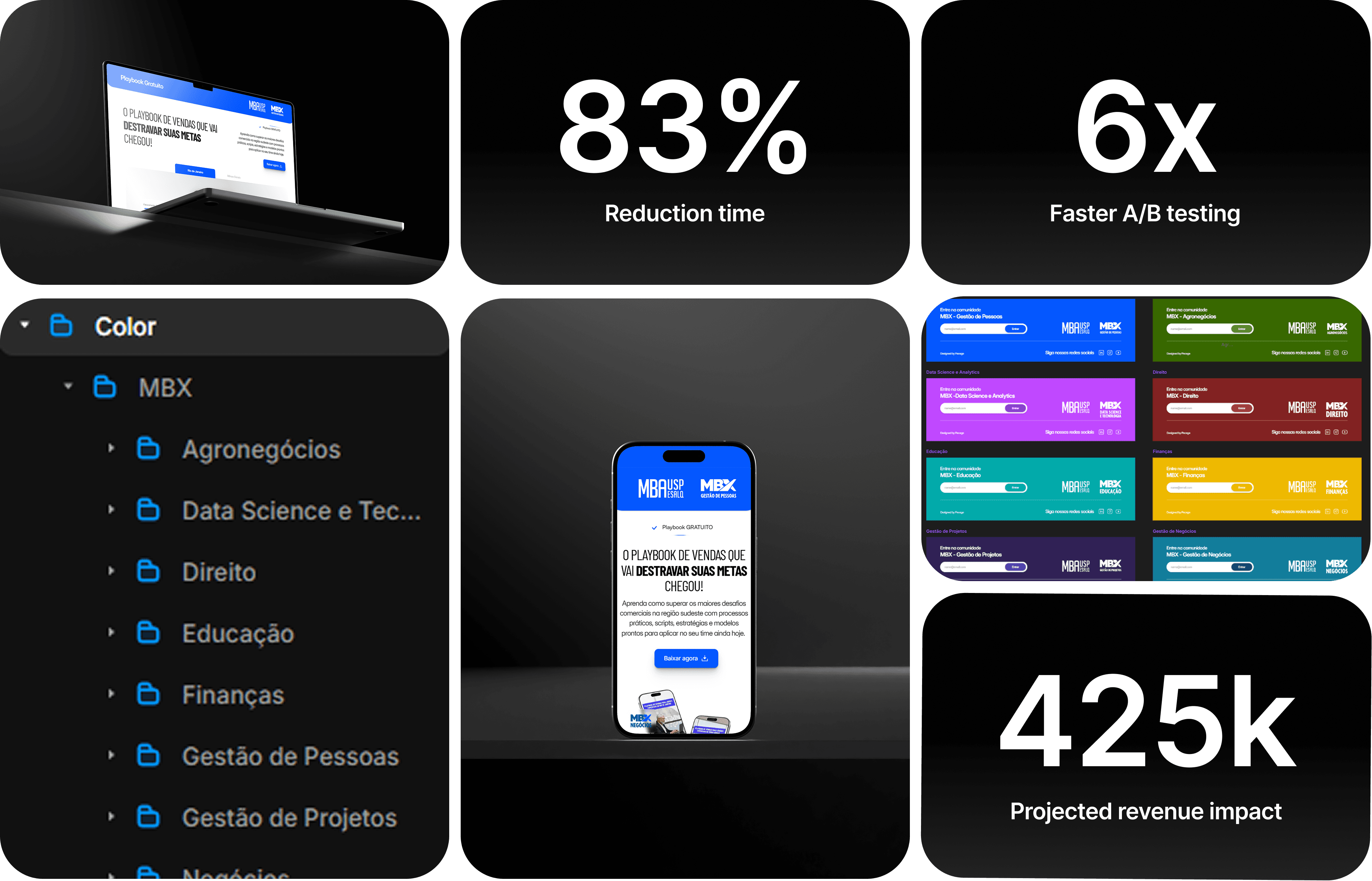
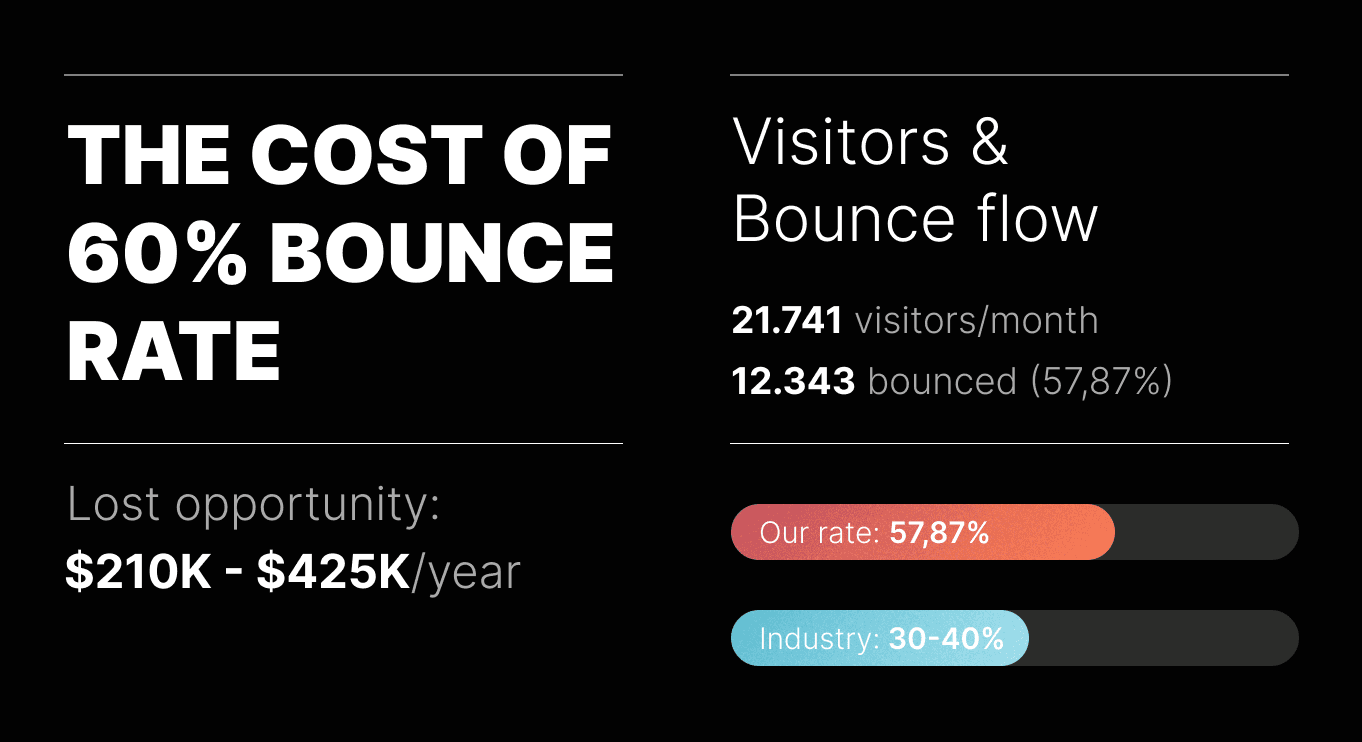
Pecege manages MBA programs for Brazil's top universities (USP/ESALQ and Poli USP), running high-volume marketing campaigns with 30+ landing pages per month. The HubSpot-based system was creating a critical conversion and productivity bottleneck — nearly 60% bounce rate and a 3-day production cycle per page.
My role
Platform evaluation, system design, component architecture, team training
Team
2 designers, marketing and content team, developers
Timeline
8 weeks — Dec 2025 → Jan 2026
Status
Implemented. Performance validation in progress (Q1 2026)
The Problem
A funnel bleeding out at three points
Problem Statement
How might we eliminate the 3-day production bottleneck and the external developer dependency so the design team can iterate faster and close the gap on a 57% bounce rate?
Before proposing anything, I partnered with the data team to understand what the numbers were actually saying. The analysis covered August 2025 to January 2026 across all active landing pages.
Three root problems
Design-to-implementation gap
What we designed in Figma never matched what came out of HubSpot. The template system forced compromises: spacing trade-offs, simplified interactions, "good enough" instead of "exactly right."
External dependency
Anything beyond basic edits required the developer. Without him, we couldn't publish. His schedule dictated ours.
Zero iteration velocity
With a 3-day turnaround, testing hypotheses was impossible. By the time a second version was live, the campaign had ended.
60% of traffic was mobile — but HubSpot's templates were desktop-first. Mobile felt like an afterthought. Average load time was 4.2 seconds against a 2-second industry benchmark. Every second over that threshold was costing conversions.
Research & Discovery
Understanding the problem before solving it
I ran a two-week discovery sprint before evaluating any solutions. The goal was to understand where things were breaking down — from every stakeholder's perspective, not just the design team's.
Conversations with designer, marketing manager, content leads and data analyst. Identified friction points from each role's perspective.
Stakeholder interviews
6 months of landing page performance data. Segmented by device, page type, and campaign. Identified where the conversion gap was largest.
Data analysis
Process audit
Mapped the end-to-end production workflow step-by-step. Measured actual time per stage. Found that 1.5 of the 3 days were pure waiting on the developer.
From the research, I defined four non-negotiable success criteria for any solution — the constraints that would determine the shortlist:
Visual design freedom
Designers must be able to build exactly what they design — no template compromises.
Brief to live in under 6 hours
The 3-day cycle was incompatible with the volume needed. 6 hours was the hard ceiling.
No external dependency
Designers must be able to publish on their own. No ticket, no wait, no handoff.
Hubspot integration
All CRM, marketing automation, and attribution runs through HubSpot.
Design Ops
Design Systems
Growth
How I reduced time-to-market by 83% to drive higher conversion in EdTech.
Moving from a 3-day developer-dependent pipeline to a 6-hour designer-owned workflow — and projecting $210K–$425K in recovered revenue for Pecege.
Design Decisions
How I arrived at each choice
1
Choose Framer
I evaluated three platforms using a weighted scorecard built around the four success criteria: visual freedom, speed, autonomy, integration, and scalability.
HubSpot scored 4.45/10; V0+Vercel scored 6.3/10 — but both still required a developer in the loop.
Framer scored 9.15/10: designers design and publish in the same tool, with no handoff.
Before formally recommending it, I validated the biggest risk: HubSpot integration.
I built a test page in Framer, embedded a HubSpot form via their standard embed code, submitted a test lead, confirmed it appeared in CRM, and triggered the automation workflow. It worked. Risk cleared.
3
Build a component library
Even with Framer, building 30+ pages per month from zero would be slow and inconsistent.
The solution was a modular system: pre-built, pre-tested blocks that designers assemble like LEGO.
Every component solves a specific conversion job. No blank canvas, ever.
I built 30+ components covering 10 hero variants, 6 CTA patterns, 4 testimonial layouts, plus supporting elements (navs, footers). The first page takes 6 hours.
By the tenth, it takes 3 — and quality compounds because every block is already tested.
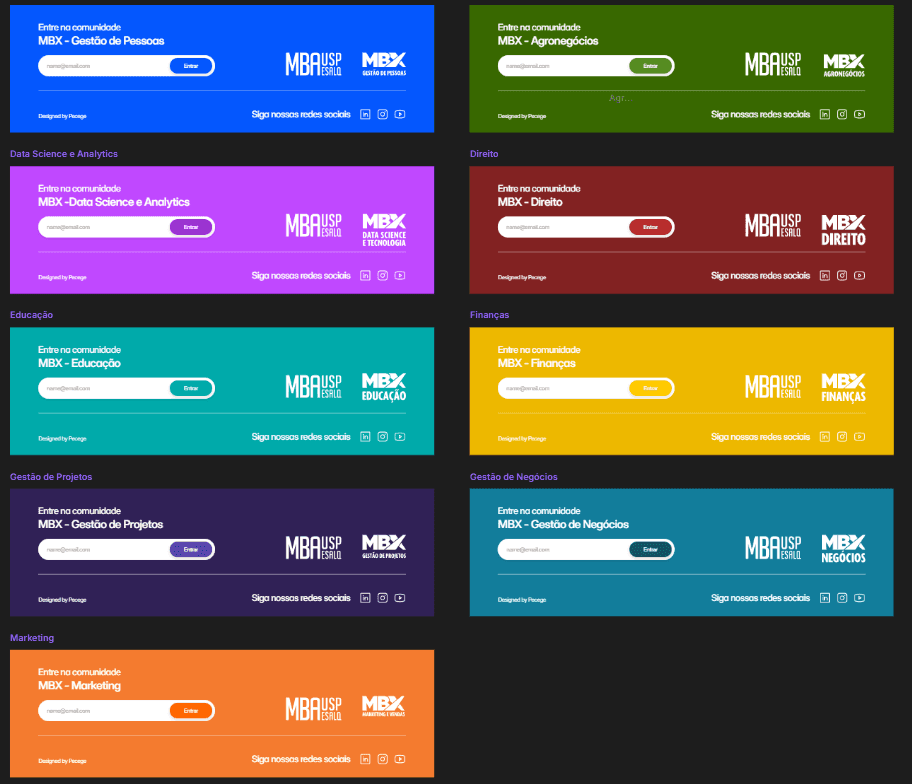
Part of the footer library
2
Mobile-first on every single component
60% of traffic was mobile. The previous system was desktop-first by HubSpot's default — mobile was an afterthought adjustment, not a deliberate design.
I flipped that logic: every component was designed for small screens first, then scaled to desktop.
Minimum touch targets of 44×44px, single-column layouts, lazy-loaded images below the fold, critical CSS inlined. Target load time: under 2 seconds.
Designing for the majority case first made the minority case (desktop) the easy part.
What changed - and what we're still measuring
83%
Reduction in production time. Validated: multiple pages built and shipped at this pace.
100%
Design fidelity. What the designer builds is what the user sees.
$210K
Conservative revenue projection
Moderate projection — 20% bounce rate reduction. Full validation data arrives end of Q1 2026.
$425K
What I'd carry into the next project
This project wasn't about making things look better—though they do. It was about
removing friction from how we work. The impact came from changing the system,
not the pixels.
Tools shape what's possible
HubSpot didn't just slow us down. It fundamentally limited what we could design.
Choosing better tools unlocked capabilities we didn't have before.
Dependencies are expensive
Every handoff costs time. Every external dependency creates a bottleneck. Giving
designers end-to-end ownership made us faster than any process optimization would
have.
Speed is underrated
Being able to test 6x more variations matters more than perfecting a single page.
In growth marketing, iteration velocity beats optimization depth.
What's next
The road ahead
Collect data
5 pages live. Tracking bounce rate, conversions, engagement, mobile performance. In 3 months we'll know if the hypothesis holds.
Scale or adjust
If data validates improvement, migrate everything and expand the library. If inconclusive, run more test variations. If worse (unlikely), reassess the approach.
Optimize
Once the foundation is validated, layer in A/B testing, dynamic content, and personalization. The system is built for this.
Rollout
How we implemented without breaking what worked
I didn't migrate everything at once — too much risk. I designed a three-phase rollout to validate before scaling, with a clear go/no-go criterion between each phase.
Phase 1: Technical validation
Built one pilot page. Tested HubSpot integration, responsive behavior, performance. Validated workflow.
Result: System works as designed.
Phase 2: Performance validation (happening now)
Migrate 5 highest-traffic pages. Run alongside HubSpot versions for 3 months. Compare bounce rates, conversions, engagement.
Phase 3: Full migration (if Phase 2 validates)
If Phase 2 validates improvement, migrate remaining pages. Scale component library.
The context
Pecege manages MBA programs for Brazil's top universities (USP/ESALQ and Poli USP), running high-volume marketing campaigns with 30+ landing pages per month. The HubSpot-based system was creating a critical conversion and productivity bottleneck — nearly 60% bounce rate and a 3-day production cycle per page.
My role
My role
Platform evaluation, system design, component architecture, team training
Team
Team
2 designers, marketing and content team, developers
2 designers, marketing and content team, developers
Timeline
Timeline
8 weeks — Dec 2025 → Jan 2026
8 weeks — Dec 2025 → Jan 2026
Status
Status
Implemented. Performance validation in progress (Q1 2026)
Implemented. Performance validation in progress (Q1 2026)
The Problem
A funnel bleeding out at three points
Problem Statement
How might we eliminate the 3-day production bottleneck and the external developer dependency so the design team can iterate faster and close the gap on a 57% bounce rate?
Problem Statement
Before proposing anything, I partnered with the data team to understand what the numbers were actually saying. The analysis covered August 2025 to January 2026 across all active landing pages.
Three root problems
Design-to-implementation gap
What we designed in Figma never matched what came out of HubSpot. The template system forced compromises: spacing trade-offs, simplified interactions, "good enough" instead of "exactly right."
External dependency
Anything beyond basic edits required the developer. Without him, we couldn't publish. His schedule dictated ours.
Zero iteration velocity
With a 3-day turnaround, testing hypotheses was impossible. By the time a second version was live, the campaign had ended.
60% of traffic was mobile — but HubSpot's templates were desktop-first. Mobile felt like an afterthought. Average load time was 4.2 seconds against a 2-second industry benchmark. Every second over that threshold was costing conversions.
Research & Discovery
Understanding the problem before solving it
I ran a two-week discovery sprint before evaluating any solutions. The goal was to understand where things were breaking down — from every stakeholder's perspective, not just the design team's.
Stakeholder interviews
Stakeholder interviews
Conversations with designer, marketing manager, content leads and data analyst. Identified friction points from each role's perspective.
Conversations with designer, marketing manager, content leads and data analyst. Identified friction points from each role's perspective.
Data analysis
Data analysis
6 months of landing page performance data. Segmented by device, page type, and campaign. Identified where the conversion gap was largest.
6 months of landing page performance data. Segmented by device, page type, and campaign. Identified where the conversion gap was largest.
Process audit
Process audit
Mapped the end-to-end production workflow step-by-step. Measured actual time per stage. Found that 1.5 of the 3 days were pure waiting on the developer.
Visual design freedom
Designers must be able to build exactly what they design — no template compromises.
Hubspot integration
All CRM, marketing automation, and attribution runs through HubSpot.
Brief to live in under 6 hours
The 3-day cycle was incompatible with the volume needed. 6 hours was the hard ceiling.
No external dependency
Designers must be able to publish on their own. No ticket, no wait, no handoff.
From the research, I defined four non-negotiable success criteria for any solution — the constraints that would determine the shortlist:
Design Decisions
How I arrived at each choice
1
Choose Framer
I evaluated three platforms using a weighted scorecard built around the four success criteria: visual freedom, speed, autonomy, integration, and scalability.
HubSpot scored 4.45/10; V0+Vercel scored 6.3/10 — but both still required a developer in the loop.
Framer scored 9.15/10: designers design and publish in the same tool, with no handoff.
Before formally recommending it, I validated the biggest risk: HubSpot integration.
I built a test page in Framer, embedded a HubSpot form via their standard embed code, submitted a test lead, confirmed it appeared in CRM, and triggered the automation workflow. It worked. Risk cleared.
2
Mobile-first on every single component
60% of traffic was mobile. The previous system was desktop-first by HubSpot's default — mobile was an afterthought adjustment, not a deliberate design.
I flipped that logic: every component was designed for small screens first, then scaled to desktop.
Minimum touch targets of 44×44px, single-column layouts, lazy-loaded images below the fold, critical CSS inlined. Target load time: under 2 seconds.
Designing for the majority case first made the minority case (desktop) the easy part.
3
Build a component library
Even with Framer, building 30+ pages per month from zero would be slow and inconsistent.
The solution was a modular system: pre-built, pre-tested blocks that designers assemble like LEGO.
Every component solves a specific conversion job. No blank canvas, ever.
I built 30+ components covering 10 hero variants, 6 CTA patterns, 4 testimonial layouts, plus supporting elements (navs, footers). The first page takes 6 hours.
By the tenth, it takes 3 — and quality compounds because every block is already tested.
Part of the footer library
The system
What changed in practice
The most important shift wasn't the tool — it was the elimination of every handoff in the production pipeline. Design and publication became a single, continuous act owned by one person.
Rollout
How we implemented without breaking what worked
I didn't migrate everything at once — too much risk. I designed a three-phase rollout to validate before scaling, with a clear go/no-go criterion between each phase.
Phase 1: Technical validation
Built one pilot page. Tested HubSpot integration, responsive behavior, performance. Validated workflow.
Result: System works as designed.
Phase 2: Performance validation (happening now)
Migrate 5 highest-traffic pages. Run alongside HubSpot versions for 3 months. Compare bounce rates, conversions, engagement.
Phase 3: Full migration (if Phase 2 validates)
If Phase 2 validates improvement, migrate remaining pages. Scale component library.
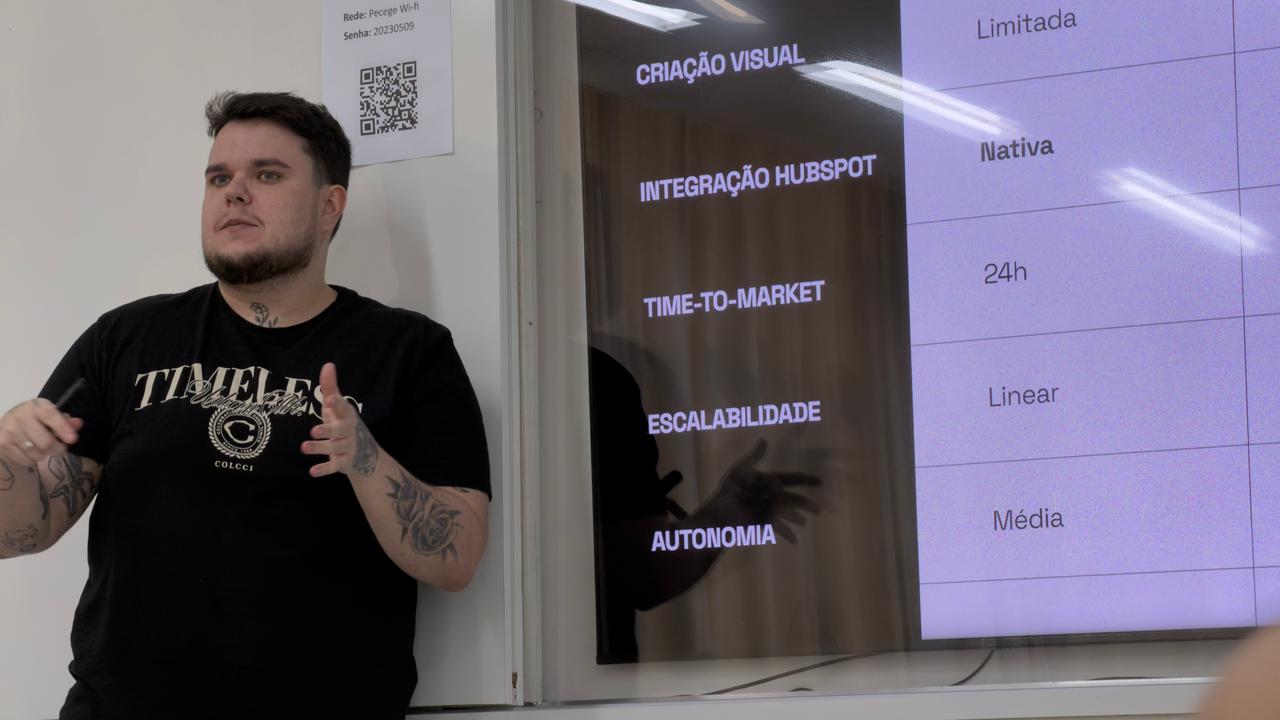
(Picture of the design workshop day)
Impact
What changed - and what we're still measuring
83%
Reduction in production time. Validated: multiple pages built and shipped at this pace.
100%
Design fidelity. What the designer builds is what the user sees.
$210K
Conservative revenue projection
$425K
Moderate projection — 20% bounce rate reduction. Full validation data arrives end of Q1 2026.
What I'd carry into the next project
This project wasn't about making things look better—though they do. It was about
removing friction from how we work. The impact came from changing the system,
not the pixels.
Tools shape what's possible
HubSpot didn't just slow us down. It fundamentally limited what we could design.
Choosing better tools unlocked capabilities we didn't have before.
Dependencies are expensive
Every handoff costs time. Every external dependency creates a bottleneck. Giving
designers end-to-end ownership made us faster than any process optimization would
have.
Speed is underrated
Being able to test 6x more variations matters more than perfecting a single page.
In growth marketing, iteration velocity beats optimization depth.
What's next
The road ahead
Collect data
5 pages live. Tracking bounce rate, conversions, engagement, mobile performance. In 3 months we'll know if the hypothesis holds.
Scale or adjust
If data validates improvement, migrate everything and expand the library. If inconclusive, run more test variations. If worse (unlikely), reassess the approach.
Optimize
Once the foundation is validated, layer in A/B testing, dynamic content, and personalization. The system is built for this.
Design meant for the real world.
Let’s build it right.
2026©All rights reserved.
Phone
Design meant for the real world.
Let’s build it right.
2026©All rights reserved.
Phone